Sunday, December 1, 2019

Vayetze: A Sense of Place


Contemporary ecologists use the term topophilia to describe the strong feeling of a sense of place, the affective bond between people and the landscapes we inhabit.  It’s an important notion, for as we envision and seek new, more sustainable life practices, it is critical to consider where we live.  Whether or not we are fully aware of it, our local ecology and geography shape all of our choices.  Environmental responsibility begins with a conscious knowledge of—and connection with—the earth beneath our feet.

Place is very much at the center of this week’s Torah portion, Vayetze.  Consider its second verse, which describes the commencement of Jacob’s long journey away from his family home in Be’er Sheva:

“He came upon a certain place and stopped there for the night, for the sun had set.  Taking one of the stones of that place he put it under his head and lay down in that place.” 

The Hebrew word makom—place—occurs three times in this short passage.  And that’s not the end of the matter.  After a few verses describing Jacob’s famous dream of a ladder connecting heaven and earth, the patriarch awakens and proclaims:  

“Surely God is in this place and I did not know it. . . . How awesome is this place!  This is none other than the abode of God and the gateway to heaven.”

The portion’s association of the Divine with a physical sense of place is so powerful that the Rabbis who read it were inspired to create a new name for God: HaMakom—The Place. 
The Holy One is intimately bound with the world in all of its particularities.  To lovingly know a particular, tangible place is an essential path toward knowing and loving God.

**********
So, too, to love the planet as a whole, we must first know and love the little corner of it that we call home.  Ecology begins in relationship with the soil we tread, the flora and fauna that share our place, the sources of our water, the clouds and stars that fill our skies.  The contours of a sustainable lifestyle are not the same in Boise as they are in Beijing or Bangladesh—or even in Portland or Seattle.  Our high desert environment should shape what we grow and eat and drink, the clothes we wear, the ways we travel and the hours that we keep.  The landscape design appropriately full of water-loving plants in the rainforest west of the Cascades is better served by xeriscaping in the rain shadow that defines our intermountain region. 
It is no accident that the Hebrew word for wilderness, midbar, comes from the verb “to speak.”  If we listen to our local ecosystem, it will speak to us.  Our challenge is to act accordingly.
When we do, we, like Jacob, might well discover: “God is in this place—and I did not know it.”

Sunday, November 24, 2019

Toldot: Food at the Forefront


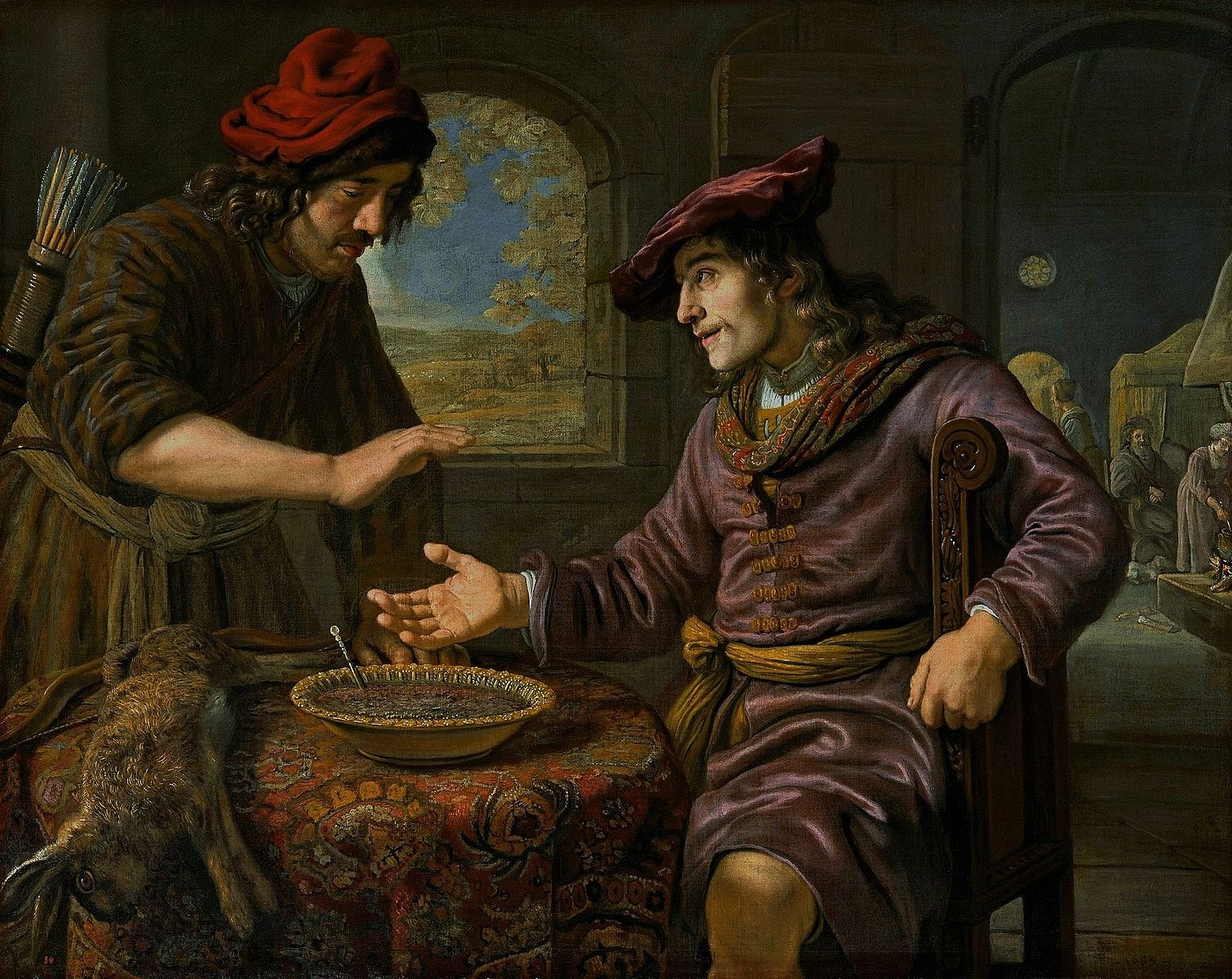
Fittingly, with Thanksgiving just a few days away, food plays a prominent role in this week’s Torah reading.  The portion, Toldot (“Generations”), begins with the birth of Jacob and Esau, and details the boys’ fraught relationship as they grow up.  Most of the drama between them happens around mealtimes.  Jacob convinces Esau to surrender his birthright in exchange for a bowl of lentil soup, then employs a dish of roasted goat to trick his father into giving him the blessing of the first born.

The preeminence of food in this sibling drama is not surprising, given how central it has been in Jewish culture for well over two thousand years.  But what really constitutes Jewish food?  In his book Rhapsody in Schmaltz, Michael Wex notes that the only uniquely Jewish food is matzah; everything else is, essentially, the standard local cuisine, adapted to fit within the laws of kashrut.  It is no accident that the foods featured in Toldot—lentils and goat meat—are universal Middle Eastern staples.  Sephardic Jewish cooking features the multitude of spices and flavors readily available in North Africa.  Ashkenazi food, by contrast, relies heavily upon the relatively few ingredients resilient enough to survive a short growing season followed by long, bitter winters: dairy products, hardy grains and root vegetables.  As the lyrics of a classic Yiddish song teach: “Monday: potatoes.  Tuesday: potatoes.  Wednesday and Thursday: potatoes.  Friday: potatoes.  On Shabbos: potato kugel.”  Where most American Jews now place parsley on our seder plates, our Ashkenazi ancestors used a potato—because it was the only “vegetable” available in March in the Russian Pale of Settlement.

What our ancestors did not know—but we do—is that this Jewish approach to eating has significant impact on our environment, especially around the issue of catastrophic climate change.  They were eating locally and seasonally long before “farm-to-table” became trendy.  We can lower our carbon footprints by emulating them.

Our ancestors also practiced the mitzvah of bal tashchit—or “do not waste.”  They lived frugally, because they had little choice.  They were, mostly, impoverished, and food was scarce.  Our challenge is to avoid waste even when we are living in prosperity.  We have a lot to do here.  According to the U.N. Food and Agriculture Organization, 30 percent of food is wasted globally across the supply chain, contributing 8 percent of total global greenhouse gas emissions. If food waste were a country, it would come in third after the United States and China in terms of impact on global warming.  As Paul Hawken notes in his book Drawdown, cutting food waste is one of the most important things we can do to combat climate change, with the same impact as reducing emissions through alternative energy sources.

Finally, we can emulate our ancestors by eating less meat.  As the old joke goes, “When a Jew eats a chicken, one of them is sick.”  Reducing the meat in our diet is another of the most effective ways to reduce greenhouse gases.

The Jewish people have a long history of conscious and conscientious eating.  In our portion, food is a source of conflict, but if we eat morally, it can be a path of healing, for us and, fittingly this week, for the toldot—the future generations—who will inherit the earth we choose to bequeath to them.

Sunday, November 17, 2019

Chaye Sarah: (Against) The Denial of Death


While the name of this week’s Torah portion, Chaye Sarah means “the life of Sarah,” the reading actually commences with Sarah’s death.  Through this ironic juxtaposition of the title and the ensuing subject matter, Torah invites us to reflect on the relationship between life and death, and the importance of coming to terms with our mortality.  The fate of our planet may depend upon it.

Ernest Becker’s groundbreaking 1973 book, The Denial of Death argues that human culture and technology are largely designed to distract us from our knowledge—and fear—of our mortality. 
Alas, because we will all, nonetheless, die, the relief is temporary and the consequences of this escapism and denial can be catastrophic, especially for the environment.  As the Ernst Becker Foundation notes on its website:

Nature is riddled with reminders of our corporeality, so maintaining order and control over nature creates the illusion that we can avoid death. We extend power over nature through heroic feats of science, technology, and economic growth. We cut our grass and fill our shopping carts to set ourselves apart from nature, which allows us to feel as though death is escapable. As Becker warned, immortality driven consumer desire, unfettered materialism, and exploitation of nature carry a dark underbelly: environmental destruction.

A sustainable life begins with the acknowledgment that we, like everything in nature, will ultimately die—that death is an essential part of life. Portion Chaye Sarah s embodies this truth.  It begins with Sarah’s death and ends with the deaths of Abraham and Ishmael—but in between it focuses on marriages and childbirth.  Abraham responds to Sarah’s demise with grief but also clear-eyed acceptance of his own morality; it leads him not into denial but rather turns his attention to the next generation. 

If we want to keep our planet alive, we must learn to accept that fact that we will die.  The “transhumanist” movement that seeks to extend human lifespans to 150 or more is deeply misguided; such a world is not sustainable.  Besides, as writer Susan Ertz observed back in 1943, “Millions long for immortality who don’t know what to do with themselves on a rainy Sunday afternoon.”  We are all of the dust, and to the dust we shall all return.

But that dust is also the source of new life.  Margaret Renkl expresses this truth beautifully in her recent New York Times essay, “Ode to a Dark Season”:
Fallen leaves soften the path I walk on, but not for my sake. The leaves fall to feed the trees, to shelter the tiny creatures who are essential to this forest in a way that I will never be. The misty rain unstiffens the wood of dead trees, making places for nesting woodpeckers to excavate next spring, making a home for the insects that will feed the woodpeckers and so many other living things. I often stop to study the woody shelf fungi growing on the deadwood. I count their rings, like the rings of a felled tree, and know how long they have been growing, how long the death of the tree has been feeding the living creatures of this forest.
November reminds us that the membrane between life and death is permeable, an endless back and forth that makes something of everything, no matter how small, no matter how temporary. To be temporary is only one part of life. There will always be a resurrection.
Indeed.  Ecclesiastes taught: “Generations come and go, but the earth abides forever.”  There is powerful truth in this—but only if we recognize and take it to heart.  For the earth to abide—and thrive—we must accept that we will die.