Friday, July 14, 2017

Upstream 30: Land's End (Wednesday, June 14, Klaipeda/Memel)

Morning breaks sunny and serene.  We're up and out early, hoping to hit the Curonian Lagoon before the wind kicks up.   During my davening, I robustly sing the line Or chadash : "Let a new light shine!"   That's how the sunlight lifts my spirits after so much stormy weather. Everything is shining. It's striking how significantly the meteorology affects my mood on an extended trip like this, where so much depends on it.  For all of our sophisticated human cultural achievements, we are still very much animals, who respond to elemental things like climate and thirst and hunger.  Weather is, in significant ways, a last vestige of wildness.  We humans control so much of the natural world, yet wind and rain remain mysteriously beyond our grasp, even to predict beyond a few days.  Back at home, moving between a comfortable house and car and office, weather conversation is often trivial small talk.  But when you live exposed to the elements, it's at the heart of things.

Viso gero.  We're off!

**********

After just thirty minutes or so of paddling, we reach the passage into the Curonian Lagoon.  Under the cerulean sky, it's lovely: wide swaths of white and yellow blossoming lily pads,  swaying reeds and sedges, delicate ripples dancing downstream.  Then we enter the lagoon itself, where everything immediately gets bigger: water, waves, and wind.  It's still beautiful, but now the paddling is very rigorous.  Even on this relatively calm, sunny day, the gusts are intense, and the water swells and splashes all around us.  Our boat handles nicely, but we still take in a great deal of spray. It's over an hour of challenging, all-out paddling before we round the point and make landfall by the lighthouse on the cape, Ventes ragas.  We pull up on the beach, clattered with muscle shells, and breathe a sigh of relief.  We're glad to be here, to rest, take stock, plan our route to Klaipeda, and, first and foremost, dry off.  The last hour's effort has left us thoroughly soaked and chilled.


Looking out over the lagoon, I offer the blessing: Baruch atah Adonai. . . sh'asah et ha-yam ha-gadol--Praised are You, Eternal One. . . who made the Great Sea.  We walk around the point, climb to the top of the lighthouse tower, enjoy the expansive view of land, river, and sea.  It's a splendid place. But neither Rosa nor I can figure out exactly how we're going to paddle up the coast in this wind.  Toward the horizon, the Curonian Spit beckons, with its lovely long, thin strip of dunes and forest that we've hoped to reach in our boat. Alas, we're not going to traverse the turbulent open bay that separates us from it any time soon.  On the far side of the spit lies the Baltic Sea.  But in this weather, it's all hopelessly out of reach.  Even larger boats are avoiding the lagoon today.  Perhaps we can kayak tight to the shore, hugging the Lithuanian mainland instead crossing to the spit.  But even this looks iffy under current conditions.  We'll revisit the question after some hot soup.

**********

Ramen helps.  So after lunch, we set out to paddle along the mainland shore.  First we have to line the boat around a rocky jetty.  Seconds after we launch that effort, it's crystal clear our plan is utterly untenable: the swelling waves that pound the leeward side of the jetty will swamp our kayak in a matter of minutes.  We head back to the beach to reassess.  The hour is late.  At this point, even if the lagoon is completely placid tomorrow and we start up the coast first thing in the morning--which is, given the weather forecast, rather unlikely--we'll still be hard-pressed to make Klaipeda by Friday evening.  

At Rosa's suggestion, I call Justas for advice.  He suggests we get in touch with Arnoldas, our contact for Friday's planned takeout and ask if he can pick us up here and drive us into Klaipeda this evening. I make the call. Arnoldas graciously agrees to meet us here in four hours.  So we spend the afternoon at the lighthouse, resting, organizing our gear, and trying to stay warm in the fierce wind.


**********

When Arnoldas arrives around 5:00, we exchange greetings,  repeatedly thank him, then hoist the kayak onto the roof of his van.  His family operates the biggest kayaking company in Lithuania, running trips all all along the Minija.  We drive north for an hour or so, drop the boat at their basecamp outside of Klaipeda,  then head into the city, where Arnoldas leaves us at the guesthouse where we've made a last minute reservation for the night.  We check in, shower, then go out for Chinese food.


**********

And then, slowly, anti-climactically, it sinks in: after three and a half weeks on the water, our kayaking journey is over, a day and a half early.  This is not the end I envisioned, paddling triumphantly into Klaipeda.  I lament that we've concluded not with a bang but a whimper.   I'm struggling to make my peace with how we've finished, to overcome my disappointment and celebrate what we've accomplished.

As I reflect upon this month's upstream expedition into my family's past, I realize we have also roughly retraced the life journey of one of my heroes,  Rabbi Yisrael ben Ze'ev Wolf Lipkin Salanter.
He was born in 1809 in Zagare, in north central Lithuania, along the Latvian border.  As a boy, he learned with Rabbi Hirsch Tzvi Braude of Salant--a town near Klaipeda (which was known in Yiddish as Memel.)   After Yisrael married  Esther Feige Eisenstein, the couple moved to Salant, where he continued to study with Rabbi Braude, and became a disciple of Rabbi Yoseph Zundel of Salant.

Rabbi Yoseph Zundel had learned in the Volozhin yeshiva, under its founder, Rabbi Chaim Volozhin. Zundel became a renowned Torah scholar in his own right who would settle in Jerusalem in 1837. His student, Yisrael Lipkin said: "I have never found a true servant of God like my mentor, Rabbi Zundel."

Zundel had a profound influence on young Yisrael's character.  He emphasized that Torah study must be accompanied by spiritual self-examination and a constant effort to sharpen one's moral virtues. Rabbi Lipkin took this to heart.  He, too, became a brilliant Torah scholar but always insisted that knowledge be coupled with ethical development, a path that he ultimately developed and popularized as Musar--a systematic psychological and spiritual regimen to perfect the soul through work on one's character traits, or midot.

**********

As his fame and reputation grew, Yisrael Lipkin became known by the name of his teacher's town: Salanter.  Given the nature of my Lithuanian journey, it is worth noting that this town is, itself, named for the Salantas River that runs through it.  I take heart in the knowledge that the father of the modern Musar movement, Rabbi Yisrael Lipkin Salanter is, essentially, named after a river.

**********

In 1842, Yisrael Salanter moved to Vilna, where he started a yeshiva of his own.  In his teaching, he emphasized the ethical writings of Rabbi Moshe Chaim Luzzato (Mesilat Yesharim/The Path of the Upright) and Rabbeynu Bachya Ibn Pakuda (Chovot ha-L'vavot/The Duties of the Heart).  Salanter believed that Jewish tradition coupled with rigorous moral development offered a vital path between rigid Orthodoxy and the assimilationist trends of Haskallah/Enlightenment.  Many agreed, as Musar spread quickly through the Lithuanian Orthodox world, though quite a few notable figures, including Kovno's renowned chief rabbi, Isaac Elchanan Spektor, opposed it as too revolutionary.

A few years after Salanter came to Vilna, the czarist government established the Vilna Rabbinical School and Teachers' Seminary, a state-run yeshiva that would bolster official Russian  control over Jewish communal life.  High ranking officials asked Yisrael Salanter to run this institution.   But Salanter feared--as it turned out, rightfully--that rabbis attending such an institution would become puppets of the state, so he declined the position. Anticipating a backlash to his refusal, he left Vilna for Kovno, where he established another yeshiva at the Neviazher Kloiz, the synagogue named for the Nevezis River that links Keidan and Kovno--where we paddled just a couple of weeks ago.  

Salanter taught there until 1857, when he moved to Prussia and eventually settled in Memel. He spent the final decades of his life working to strengthen Musar--and Orthodox Judaism--where it was most challenged, in communities deeply influenced by the Enlightenment: here in Memel,  and in Konigsberg, Berlin, and Paris.  He died in Konigsberg in 1883.

**********

Metaphorically-speaking, Rabbi Yisrael Lipkin Salanter's life journey went upstream, from Vilna and Kovno, the Orthodox heartland of yeshiva life and learning in Lita, to the cosmopolitan western world of Prussia, Germany, and France.  He moved from traditional bastions to the edges of Jewish life, where he strove to preserve tradition by renewing it with Musar.  

In the opening of his classic epistle, Iggert Ha-Musar (the Musar letter), Salanter wrote:

The imagination is an overflowing river, and the intellect will drown unless we place it on a boat. The boat is the awakening [of reverence for God] in the soul and the fear [of God's punishment] in our spirit.

I have deep respect for the Musar tradition.  It has had a profound influence on my family, starting with my great uncle, Shimon Finkelstein, who was a student of Salanter's most renowned disciples in Slabodka: Rabbis Natan Finkel, Yossel Horowitz, and Yitzchak Blazer.  The revitalization of Musar in the liberal Jewish world, largely due to the efforts of Alan Morinis, has been an invaluable aid in my efforts to examine and renew my own spiritual life.  

So I find myself drawn to Salanter's metaphor of imagination as a river that threatens to drown the intellect unless it can find a boat.  Yet as much as I love boats and rivers, the image doesn't entirely work for me.  I have always wished for more, not less, imaginative power.  I think I trust rivers--both real and metaphorical--a bit more than Salanter did, even if his name derives from one.  Yes, rivers--and imaginations--can run wild.  They overflow and flood, and in the process, cause terrible damage. Yet they  also draw down,  dry out, and disappear in times of drought--and this is no less dangerous than overabundance and flooding.  Like everything in Musar, rivers and imagination are ultimately all about balance.  We need both the rivers and the banks that define and contain them.  But I don't want my streams to run too tame.  I long to ride the rivers, to paddle with them, to laugh and celebrate and dance and pray with them, despite--or, really, because--of their whimsy.  Chaos and capriciousness is essential to their beauty.   A fierce untamable wildness is at the heart of what I love most about rivers.

And imaginations.  

And  God.

**********

Now the river lies behind us.  We're safely ensconced in Klaipeda, warm and comfortable, with the luxury to reflect on the past month's pilgrimage.  No, I did not get the journey's end that I envisioned. Tough luck.  That's how it usually goes.  We don't often write the conclusions to our own narratives. This Shabbat, we will read Sh'lach L'chah, the tale of the spies that Moses sends to scout out the Promised Land, just a year and a half after leaving Egypt. The parsha marks the turning point for the wilderness generation--or, more precisely, the lack of a turning point.  As the story goes, the Israelites raised under Egyptian slavery are unable to muster the faith and courage to enter the land of Canaan.   They blow their chance, and so, in Sh'lach L'chah, they are condemned to wander for forty years, until they die out in the desert.  Their children and grandchildren, born into freedom, will inherit the land of Israel.  Even Moses does not escape his generation's judgment; he will see the land from afar, atop Mt. Nebo, but die before crossing the Jordan.  This is not the ending that either dor ha-midbar or Moshe Rabbeynu--the wilderness generation or their leader, Moses--would have chosen for themselves.  But it's what they get.  It's fascinating, then, that much later, the Rabbis of the Talmud look back on this time in the desert with great admiration and nostalgia.  They overlook the kvetching and rebellion and note that while the Israelites in the wilderness did not make it to the Promised Land, they had the privilege of standing at Sinai, to receive the Torah for time immemorial. Their happy ending is the gift of Torah, and that gift endures.

Rosa and I will stay the night here.  Then, instead of paddling, we will take a ferry and a bus to Nida, on the Curonian Spit, for a day and a half before returning on Friday afternoon for our final Shabbat in Lithuania.

It's a quiet culmination, without fanfare--the unplanned conclusion of a spirited journey.

It's not what we chose.  It is, nonetheless, an extraordinary blessing.

Wednesday, July 12, 2017

Upstream 29: The Waiting (Tuesday, June 13, Minija River, between Minge and Vente)


We wake to ominous grey skies, with rain expected throughout the day, but it hasn't started yet, so I scurry to get the tent packed dry, before the squall arrives.

Note to self: As you make haste, don't forget to appreciate the moment--even if you're paddling, cold and damp, into fierce headwinds.  Pay attention to beauty.  Notice something a little out of the ordinary, and be thankful for it.  Remember that each hour is precious, for at day's end,  we will be halfway through our journey's final week.

**********

Abbreviated davening this morningin the tent, without tallit and tefillin, which I do not wish to risk getting wet.  I am tempted to skip it entirely, but am glad I don't.   Regular morning prayer grounds starts the day right, grounding me in the kind of mindfulness and gratitude that I lacked yesterday and which may not come easily today either.  I want to acknowledge the Holy One as the creator of everything--not just sunshine and joy but all of it: clouds and wind and wet, storm and struggle.  I need the power of ritual routine to push me out of my small, anthropocentric, self-centered perspective.  Why should the weather give a damn about me, really?  What kind of world would it be if it did?  I want to love the Creation as it is, the Holy One's handiwork.  All of it.  

**********

We break camp and paddle for two hours. It's tough going with strong gusts blasting us head on, but at least the rain holds off. We push our way downstream tightly hugging the right bank, where the wooded shore acts as a bit of a windbreak.


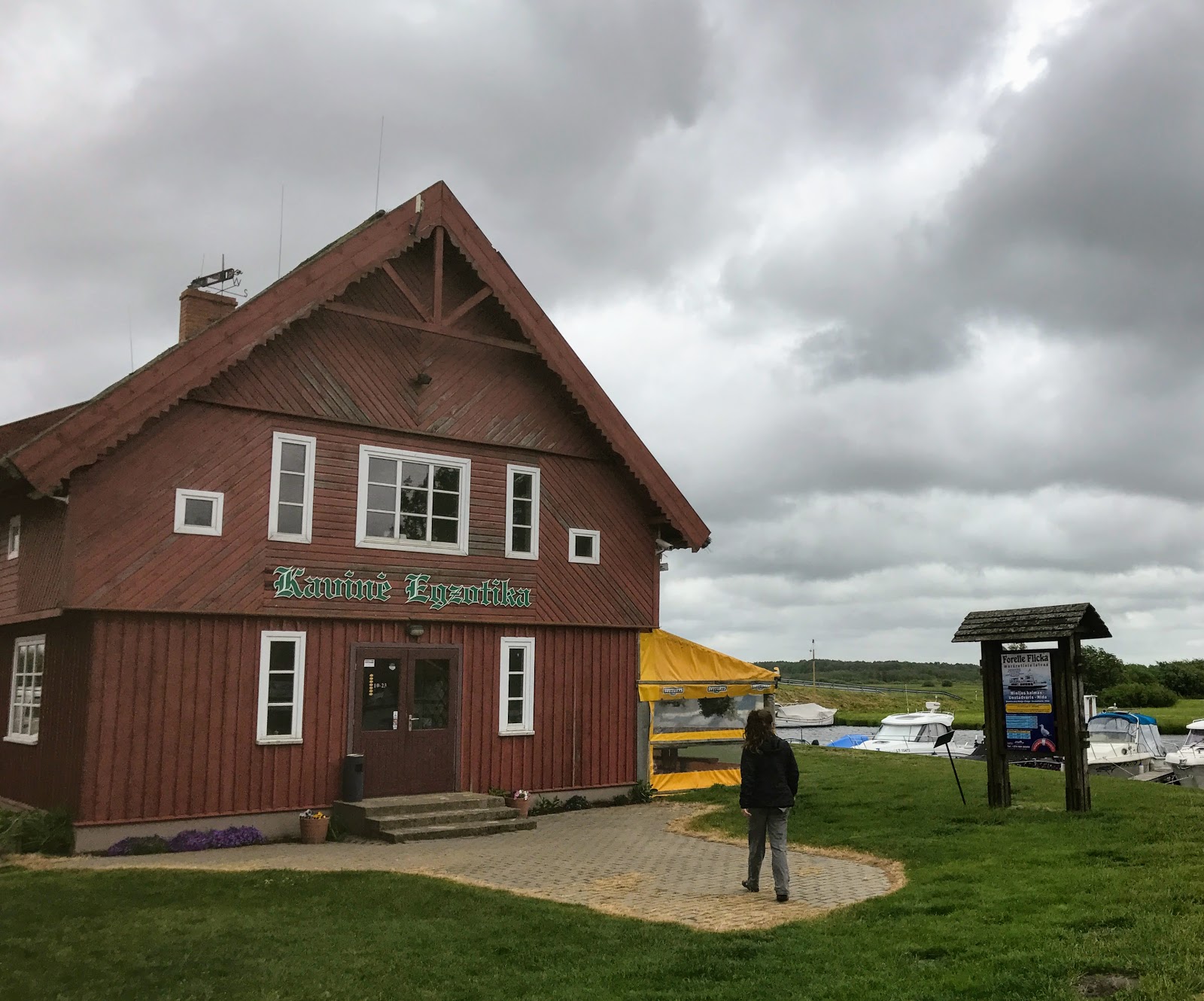
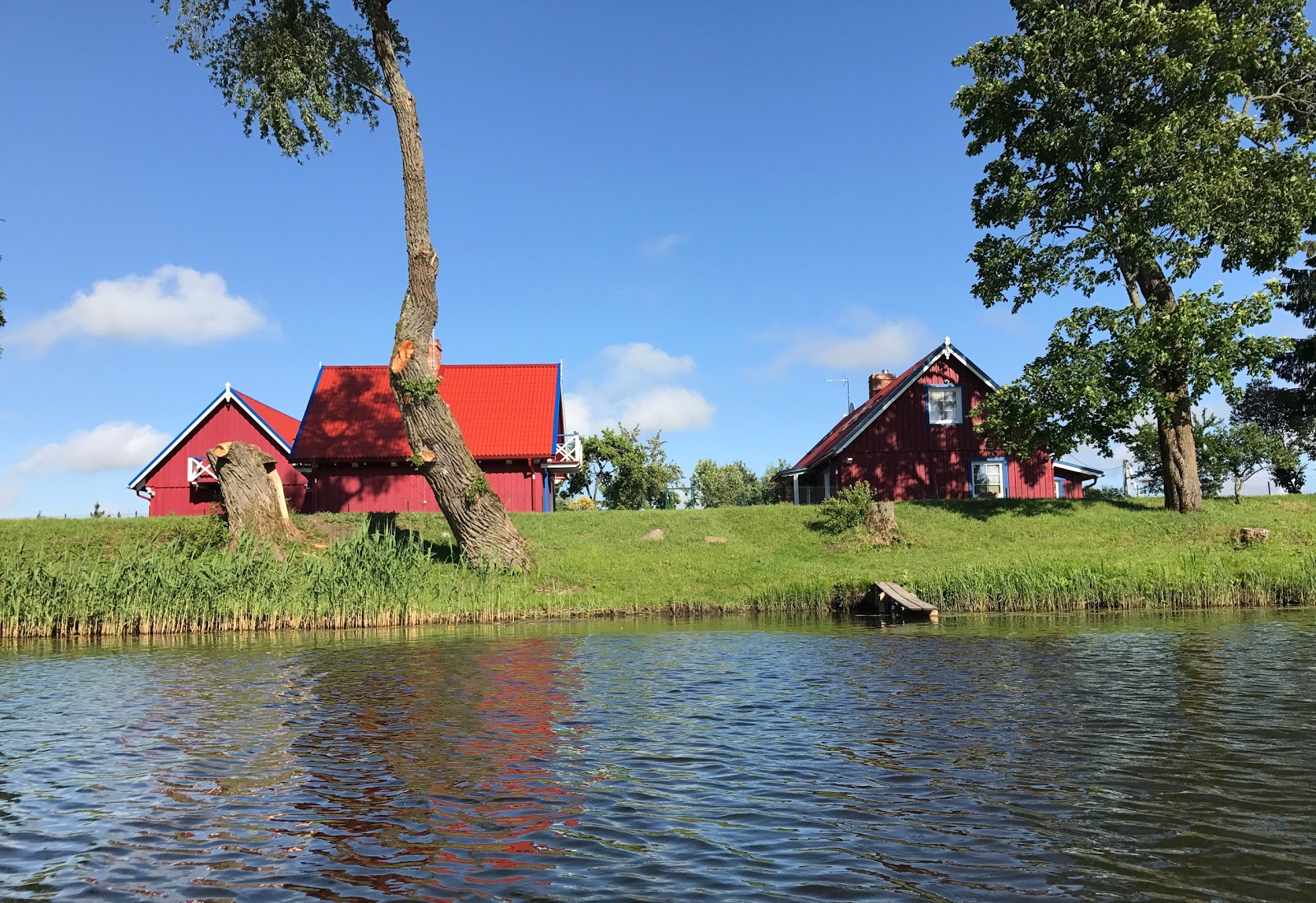
By 12:30 or so, we spy the first signs of the approaching delta.  The landscape opens up into expansive marshlands, gently sloped banks, wind-scoured grasses.  We snake our way through, then come around a broad bend and enter Minge. It's a unique place, a quaint fishing village turned tourist town, where the only "road" is the river--leading the guide books to describe it as "the Venice of Lithuania."  This is a considerable overstatement (no one looks at Venice and thinks, "That's the Minge of Italy!") but it's lovely, with picture perfect fairy tale inns and vacation cottages lining both sides of the stream.  We tie up the boat and walk along the right bank, passing yachts and guesthouses, then return to the kayak, paddle across the river, and dock again, this time on the left bank, where we find the town's only restaurant/cafe, the Kavine Egzotica.  The lunch menu doesn't offer much vegetarian fare, so we turn to the snack section and ask for fried bread with cheese and garlic, thinking we'll get glorified grilled cheese.  We don't.  Twenty minutes or so after taking our order, the waitress sets down two huge bowls of deep-fried croutons smothered in melted cheese and mayonnaise. It's so ungodly rich and heavy; we can barely make a dent in even one of the bowls, . As Rosa puts it, you know it's not a healthy meal when the french fries on the side are more nutritious than the main course.  


Back on the river, things are sluggish at best.  We're badly bloated from the cheese bowls and buffeted by the wind, which is now whipping upstream even harder than before Minge.  Heavy rain looks imminent, and we consider calling it a day and finding a place to stay in town.  But in our eagerness to reach Vente and the Curonian Lagoon, we press on.

Before long, we realize we've made a mistake.  Progress is painful as we paddle into the squall, but there's no turning back here, with Minge now several significant upstream river bends behind us.  On this slate-grey day, the landscape is comprised of just two tones: the verdure of the meadowlands and the gunmetal sky and water.  It's elemental, this world of grey and green, wind and waves, water and marsh grass.  Bleakly beautiful.

Also a little scary.  We don't have as much control as we'd like in our battle with the elements; every few feet gained on the river is hard-earned.  We're pushing for Vente, for the lighthouse at the cape that marks land's end, where we will enter the bay.  Caution is in order, for we have a river kayak with no spray skirt.  It has served us well for the last three and a half weeks, but it is not built for the open sea.  Still, it will be so nice to reach the ocean,  to feel the spacious salt air on our faces.

**********

Delayed gratification.  Again.

This painstaking final leg of our journey keeps pounding that lesson into my thick, recalcitrant skull. Another frustrating day where we do not make it to the sea.  After lunch, we paddle almost an hour, and with every stroke, the going just grows tougher.  The waves get scary, heaving upstream, river-wide, impeding virtually any forward progress.  Rain slaps our cheeks, wind gusts against our upraised paddle blades.  Finally, we throw in the towel.  We pull the boat onto the right bank, thick with weeds, determined to wait out the storm.  An hour passes, then two.  No change, no clearing.  So we call it a day, even though it's still early afternoon.  When the rain eases for a few minutes, we hastily pitch and pack the tent with our sleeping gear; by the time the deluge picks up again, we are gratefully ensconced inside.  For the rest of the day and into the night, we chill in the tent, watching Netflix: a photo documentary from the Himalayas followed by a Swedish film, with subtitles, about a rash of witch trials in a seventeenth-century fishing village--essentially a Scandinavian version of "The Crucible."  In between, we boil up some freeze-dried pasta, talk and laugh and play a lot of gin rummy.  We're happy to be warm and dry and comfortable.  Today, the waiting isn't too bad.

**********

Luckily, as the late twilight descends, the storm starts to clear.  We go to sleep with the rainfly doors open, hoping for smoother waters tomorrow.  Vente and the Curonian Lagoon lie just a couple miles ahead.  Weather-permitting, we should make it in the morning.


Tuesday, July 11, 2017

Upstream 28: Shall We Gather at the River? (Monday, June 12, Minija River near Vabalai)

We wake to a hard rain slapping against our tent.  Hoping for better weather to greet the day, we try going back to bed several times, but in the end we can't outsleep the storm.  So I cook up a quick breakfast, daven in the tent, and we push out into the river around 10:30.

It rains, on and off, for most of the day.  Over the course of just a few hours of paddling, the river widens and deepens significantly.  The small, intimate stream where we launched yesterday has become a significant estuary, emerging from the forest into open countryside.  It now resembles the Neris on our opening stretch from Vilna to Kovno.  Closing the circle, as it were, finishing as we began.  All rivers flow to the sea, says Ecclesiastes, yet the sea is never full.  The ocean may not overflow, but its tributaries certainly expand as they draw near to fill it.

Philosopher and ecologist Kathleen Dean Moore writes about this in her book Great Tide Rising:

Contrast the growth pattern of aspen trees, the dusty yellow trunk dividing into branches into twigs into leaders and leaves, with the growth pattern of streams.  Tiny rills in the shadows of snowfields join streams that join waterfalls that gather in rivers that flow through gravel plains to the one great sea.  Why do trees endlessly divide but rivers eternally gather?

Rivers gather: water, people, culture.

Souls.

The psalmist wrote: "As a deer longs for flowing streams, so does my soul long for you, Eternal One."

Shall we gather at the river?  


**********

We enjoy a damp lunch in a lovely spot, by a graceful footbridge over the Minija.  I walk across, a little jittery as I always get on high cable bridges, singing Rebbe Nachman of Breslov's mantra Gesher Tza'ar m'od to calm my nerves.  All the world is a very narrow bridge, and the main thing is to not be too afraid. . . 


**********

I learn--or, more accurately, re-learn--an important lesson today.

I have always preached that the journey is more important than the destination.  A pilgrim strives to live fully in the moment, rather than constantly wondering, "Are we there yet?" This wisdom is deeply embedded in the Torah.  Even if one accepts, literally, the Exodus narrative of over a million Israelites leaving Egypt, we could have easily walked from there to Israel in just a few weeks.  So why does the desert crossing take four decades?  Our forty years in the wilderness are all about the journey, about the formation of a people.  Along the way, at Sinai, God tells Moses, "Go up on the mountain and be there."  Physically-speaking, this is redundant.  Where else would Moses be?  But as a metaphor for mindfulness, it is spot on.  The Holy One is asking Moshe Rabbeynu to be fully present, mentally and spiritually, to model for us, the Jewish people, a path of attentiveness and gratitude.

I forgot this wisdom today.

I spend way too much of our time on the river expecting to make it to the Nemunas Delta, anticipating our imminent arrival at the Sea.  Indeed, I even book accommodations for tonight at an ornithological research center in Vente, where the river empties into the Curonian Lagoon.  These plans prove wildly overambitious and grossly premature.  We are not going to make it nearly that far. My fervent hope and intense desire to reach the Delta only make the day a miserable slog--not on account of the actual level of difficulty so much as the dashed expectations.  The ongoing rain and headwinds don't help but even when the weather clears, around 4:00, I'm still wretched and cantankerous, because instead of enjoying the river, the scenery, and the sunshine--all of which are truly lovely--I'm too busy muttering to myself over our lack of progress.

Lesson learned, again.  Now, to take it to heart. . . 


**********

We finally set up camp, exhausted, at 7:30.  Rosa cooks lentils and rice, which warm both the stomach and the spirit.  We crawl wearily into the tent for an early bedtime.  Rain is expected all night and all day tomorrow. After that, we hope, clearing.

**********

To reinforce today's lesson in mindfulness, I'm reading Dr. Sheryl Kujawa-Holbrook's book, Pilgrimage: The Sacred Art--Journey to the Center of the Heart.  She reminds me of the Talmud's injunction: "God wants the heart."  Then she adds:

What most distinguishes the sacred art of pilgrimage from a tourist trip or hiking expedition, as beneficial as these are, is the characteristic inward journey, a turning of one's heart to the Divine with the expectation of transformation on every level of being along the way. . . . Even in relative solitude a pilgrim is always in relationship--with the self, with the Divine, with the natural environment, and with those they leave behind.

**********

How much, and how consistently, have I offered up my heart on this journey?

Not enough.  Perhaps I am, as usual, too caught up in my head.   Too much thinking, not enough feeling.  Maybe I should spend less time in solitary pursuits like this one--writing--and more time sharing and listening and just being fully present and attentive with Rosa.  

God wants my heart.  If this journey does not prove transformative, it will not be the pilgrimage that it might have become.  

Still, I remind myself, transformation happens slowly, and continues after the physical journey's end. I do not want to be too quick or condemnatory in judging myself.


**********

Shall we gather at the river?

So asks the old African-American spiritual.  It continues:

Soon we'll reach the silver river
Soon our pilgrimage will cease
Soon our happy hearts will quiver
With the melody of peace.

It's no surprise that I love this hymn.  Shall we gather at the river?  Yes!  Where better to come together?  The river is our life, our dreams and failings and potential transformation.  It is, like this journey, bustling and blessed with community.  Our pilgrimage takes a village.  It takes a river.

Yes, soon our pilgrimage will cease.  In the hymn, this line is a poignant metaphor for our mortality, a reminder of this life's precious little time before we  cross over Jordan to whatever comes next.  For Rosa and me, the words are also quite literally accurate: our expedition is nearing its end.  The river will cease at the Sea.  

So once again, bedtime reminder to self: Stop looking downstream and enjoy the river, here and now. 

Each bend.  Each meander.  

The Sea will bring its own blessings and challenges, in due time.


Monday, July 10, 2017

Upstream 27: Sometimes a Great Notion (Sunday, June 11, Minija River, near Ziaukos)

We plan to launch this afternoon in Gargzdai, on the Minija River.  In Yiddish, the town was known as Gorzd. Like Keidan, it was built on land belonging to the Radvilla family, a line of prominent Protestant nobles known for their tolerance and entrepreneurism.  Napoleon's army camped here on their fateful march toward Russia in 1812.

Gorzd's Jewish community was one of Lithuania's oldest, pre-dating the much larger city of Memel/Klaipeda, where we plan to finish our journey at week's end. Documents dating back to the fifteenth century cursorily mention Jews serving as tax collectors in Gorzd.  Memel's Jews buried their dead here up until the partition of Lithuania in 1795, when Memel became part of Prussia, while Gorzd ended up in the Russian Pale of Settlement.  

Here, as in so many other river towns we've passed through over the last three weeks, a significant portion of the Jewish community earned a living in the lumber industry, cutting timber and floating it downstream to larger commercial centers.  Last year, while camping on the Oregon Coast, I read Ken Kesey's novel, Sometimes a Great Notion.  Set in a small Oregon estuary town, it tells the tale of a stubborn old logging family struggling against both natural obstacles, like water and weather, and human adversaries, especially the labor unions. The world depicted in the story is often brutal, defined by cruel injuries, petty personal slights, and at least one drowning.  It is an epic novel but also very goyishe--even though half-Jewish Paul Newman played the lead character, Hank Stamper in the Hollywood movie version.  Ken Kesey certainly didn't imagine Jews in this line of work.  Yet here in Lithuania, lumber was a  Jewish business.

Because of its proximity to Prussia, many Gorzd residents were drawn toward modernist, Enlightenment Jewish trends.  Pinkas Kehillot Lita notes that the Jews of Gorzd were open to the influence of German culture and most of them knew how to speak German.  In the interwar years of independent Lithuania, Gorzd prospered, as the community exported flax, animal hides, chickens, beans, and other merchandise to Germany.  By 1939, Gorzd had essentially become a commuter village, as 80% of the residents went off to work in Memel.  

Then the Nazis annexed Memel and Gorzd suddenly became a border town again.  Too close to the Nazis for comfort, the Jewish residents with the means to leave usually did.  The lucky ones found refuge in the US and South Africa; most fatefully fled east, to other parts of Lithuania, where the Nazis caught up with them just two years later.  In September of 1941, those who remained in Gorzd were murdered in the forest, largely by Lithuanian nationalists.  As Pinkas Kehillot Lita recounts the tragedy:

Only one woman, Rachel Yomi, was able to save herself by pretending that she was dead, and she is the single witness to what happened.  A Lithuanian teacher named Gritzius. . . concealed her during all the years of the war.  After the war, Rachel married her rescuer.


**********

Unbelievable.  To witness and survive the massacre of your entire family, all of your friends and neighbors.  To be left for dead,  hidden--and then to marry your non-Jewish rescuer.  Can we imagine what bonds sustained--and strained--such a marriage?  Today--June 11--is my own anniversary. What would it be like, I wonder, to live in partnership with one to whom you literally owe everything? How could Rachel Yomi endure life in this place after the war ended, given all she'd seen and lost?  Oh how I wish I could hear her tale! Alas, there is no record.

So in lieu of her words, a poem by Abraham Sutzkever, originally in Yiddish and translated by Cynthia Ozick.  It is dedicated to Yanova Bartoszewicz, the Polish woman who hid Sutzkever in her cellar and brought food to his family in the Vilna Ghetto during a period of mass liquidation in late October of 1941.  Sutzkever later planted a tree in her honor at the Yad Vashem Holocaust memorial in Jerusalem:

1980

And when I go up as a pilgrim in winter, to recover 
the place I was born, and the twin to self I am in my mind, 
then I'll go in black snow as a pilgrim to find 
the grave of my savior, Yanova.

She'll hear what I whisper, under my breath: 
Thank you.  You saved my tears from the flame.
Thank you.  Children and grandchildren you rescued from death.
I planted a sapling (it doesn't suffice) in your name.

Time in its gyre spins back down the flue 
faster than nightmares of nooses can ride, 
quicker than nails.  And you, my savior, in your cellar you'll hide 
me, ascending in dreams as a pilgrim to you.

You'll come from the yard in your slippers, crunching the snow 
so I'll know.  Again I'm there in the cellar, degraded and low, 
you're bringing me milk and bread sliced thick at the edge.  
You're making the sign of the cross.  I'm making my pencil its 
      pledge.

**********

Early in the afternoon, Justas picks us up at the B&B in Jurbarkas.  He and the owner warmly exchange greetings; as it turns out, Justas stayed here on vacation just a couple years ago.  She is an impeccable hostess-- kind, industrious, and very welcoming.  Just what we needed this weekend.

We drive about three hours to the put-in, making a few wrong turns along the way.  No matter.  Justas is, as usual, in high spirits.  He mentions that he's working to line up some media interviews for Rosa and me at trip's end.  This would be good publicity for him and his business--and he deserves it. We're happy to support this, as Justas has been invaluable--and a real mentsch.  He drove hours to reach us today, resupplied us with a fresh canister of fuel, and, between business calls, eagerly shares his ample knowledge of Lithuanian history along the road.  He's a spirited entrepreneur,  constantly juggling an eclectic array of enterprises and interests.  He expresses great pride and intellectual curiosity in our journey across his country, and his role in it.  This brings me joy; it feels like a small yet significant act of tikkun, of healing, in the long history of Jews and Lithuanians that is in deep need of such measures.  

**********

We're at the river around 4:00 pm, our last and latest launch of the journey.  Justas drops us off at a gently-graded put-in beside a shady bridge over the Minija in the heart of Gargzdai.  We're heavy-laden, with a fresh supply of food, and, for the first time, over fifteen liters of fresh water stashed in the hull.  We'll need it on the Curonian Lagoon, a bay of the Baltic Sea, where we're expecting brackish water that doesn't serve for either drinking or cooking.  We bid Justas farewell for another week, until our expedition's end, and push off into the stream.


A few minutes later, we hit our first dam on the Minija.  Uztvanka.  Ugh.  We've certainly learned and come to loathe this Lithuanian word.  Thankfully, it's not too difficult to line the boat through this one.  We're learning the drill.  Below the dam,  Rosa and I switch things up a bit.  For the first time in three weeks, we change positions in the kayak: she takes the stern and I move up front to the bow. But after just an hour or so, we swap back, both of us preferring our usual set up, where I steer and Rosa navigates and provides the power.  Over the course of the journey, we've developed a strong working partnership with a good rhythm, and we're sticking with it.

**********

As evening falls, we glide down what may be our favorite stretch of river so far.  The water is extraordinarily clear, with a steady current (most unlike the Nevezis) and just enough riffles, rocks, and overhanging branches to keep things interesting.  After almost a week on the Nemunas, it's a pleasure to be back on a smaller, more intimate stream. Although there is no real wilderness left in a place as small and long-settled as Lithuania, this section of the Minija, with its steep and densely forested banks feels wild and free-flowing.  Rosa puts it beautifully: The forest is hugging us.  At times, we might imagine ourselves in Canada or northern Idaho as the river dances through boreal woodlands, with frogs and songbirds playing the tune. 

**********

We pitch our tent around 7:45, boil pasta, and savor the lingering honeyed evening from our campsite under the pines.  It's a peaceful, meditative time.  Now to bed. Tomorrow, hopefully, a rigorous paddle to land's end at the Nemunas Delta.